NAR: Nearly 90% of Metro Areas Registered Home Price Gains in Fourth Quarter of 2024
WASHINGTON—Almost 90% of metro markets (201 out of 226, or 89%) experienced home price increases in the fourth quarter of 2024, as the 30-year fixed mortgage rate ranged from 6.12% to 6.85%, according to the National Association of Realtors’ latest quarterly report. Fourteen percent of the 226 tracked metro areas posted double-digit price gains over the same period, up from 7% in the third quarter.
“Record-high home prices and the accompanying housing wealth gains are definitely good news for property owners,” said NAR Chief Economist Lawrence Yun. “However, renters who are looking to transition into homeownership face significant hurdles.”
Compared to one year ago, the national median single-family existing-home price elevated 4.8% to $410,100. In the previous quarter, the year-over-year national median price increased 3.2%. In the past five years, from 2019 to 2024, the median home price rose by 49.9%.
Among the major U.S. regions, the South registered the largest share of single-family existing-home sales (45.1%) in the fourth quarter, with year-over-year price appreciation of 2.1%. Prices also increased 10.6% in the Northeast, 8.0% in the Midwest and 4.0% in the West.
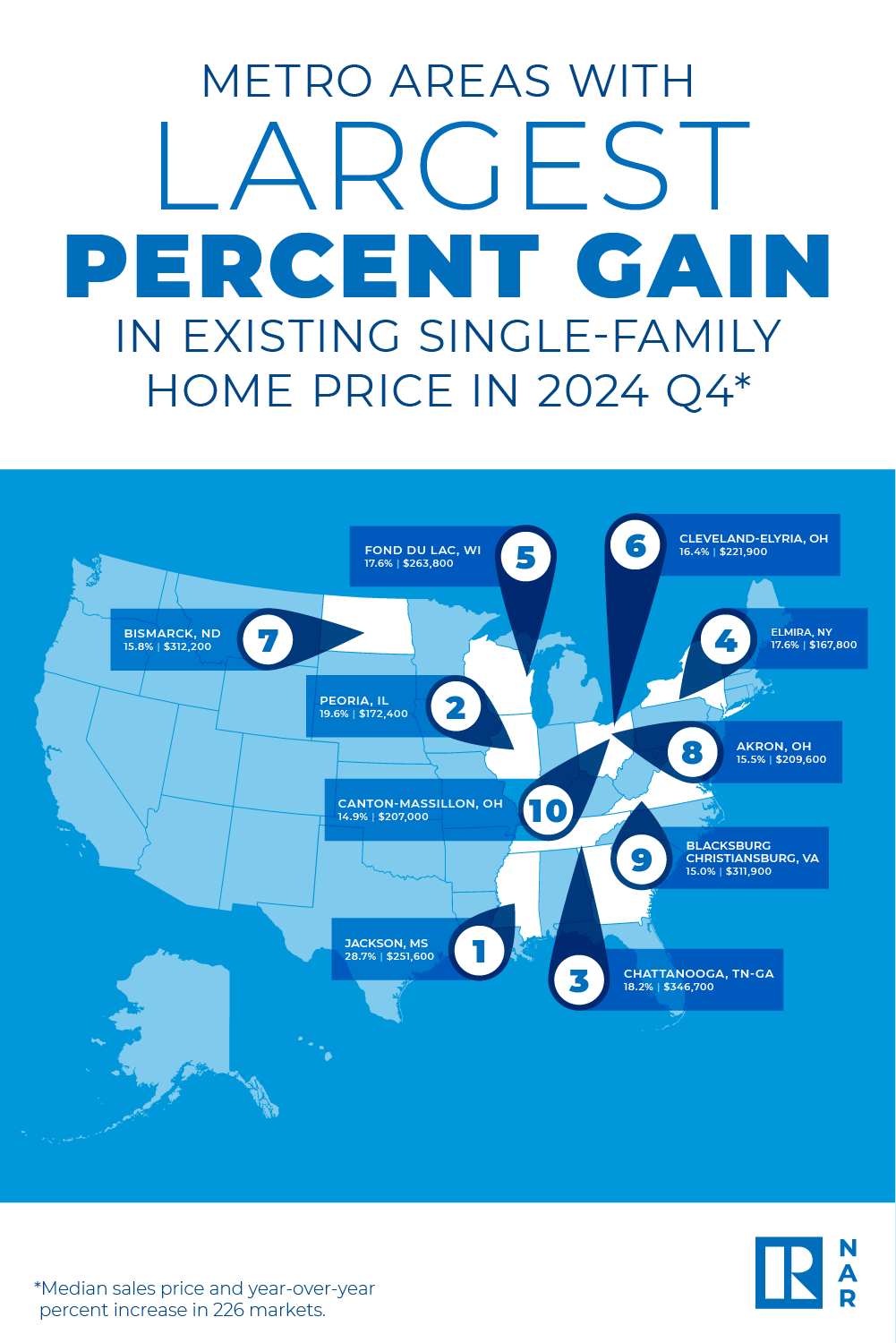
The top 10 metro areas with the largest year-over-year median price increases, which can be influenced by the types of homes sold during the quarter, all experienced gains of at least 14.9%. Six of the markets were in the Midwest. Overall, those markets were Jackson, MS (28.7%); Peoria, IL (19.6%); Chattanooga, TN-GA (18.2%); Elmira, NY (17.6%); Fond du Lac, WI (17.6%); Cleveland-Elyria, OH (16.4%); Bismarck, ND(15.8%); Akron, OH (15.5%); Blacksburg-Christiansburg, VA (15.0%); and Canton-Massillon, OH (14.9%).
Eight of the top 10 most expensive markets in the U.S. were in California. Overall, those markets were San Jose-Sunnyvale-Santa Clara, CA. ($1,920,000; 9.7%); Anaheim-Santa Ana-Irvine, CA ($1,360,000; 4.7%); San Francisco-Oakland-Hayward, CA ($1,315,600; 5.2%); Urban Honolulu, HI ($1,103,100; 3.2%); San Diego-Carlsbad, CA ($985,000; 5.7%); Salinas, CA ($943,900; -5.0%); Los Angeles-Long Beach-Glendale, CZ ($939,700; 6.3%); San Luis Obispo-Paso Robles, CA ($927,200; 1.7%); Oxnard-Thousand Oaks-Ventura, CA ($920,000; 0.3%); and Boulder, CO ($840,700; -1.0%).
Almost 11% of markets (24 of 226) experienced home price declines in the fourth quarter, down from 13% in the third quarter.
"While recognizing many workers may not have the option to relocate, those who can or are willing to move may find more affordable conditions, especially given the wide variance in home prices nationwide," Yun said.
Housing affordability marginally improved in the fourth quarter. The monthly mortgage payment on a typical existing single-family home with a 20% down payment was $2,124, down 0.8% from the third quarter ($2,141) and 1.7%—or $37—from one year ago. Families typically spent 24.8% of their income on mortgage payments, down from 25.2% in the previous quarter and 26.5% one year ago.
First-time buyers found slightly better affordability circumstances compared to the prior quarter. For a typical starter home valued at $348,600 with a 10% down payment loan, the monthly mortgage payment declined to $2,083, down 0.9% from the previous quarter ($2,101). That was a decrease of $35, or 1.7%, from one year ago ($2,118). First-time buyers typically spent 37.4% of their family income on mortgage payments, down from 38.1% in the prior quarter.
A family needed a qualifying income of at least $100,000 to afford a 10% down payment mortgage in 43.8% of markets, up from 42.5% in the previous quarter. Yet, a family needed a qualifying income of less than $50,000 to afford a home in 2.2% of markets, identical to the prior quarter.