NAR Chief Economist Says Mortgage Rates’ Fast Rise Hurt Housing Market
WASHINGTON—National Association of Realtors Chief Economist Lawrence Yun said existing home sales will increase by 6% in 2025 and by 11% in 2026 during the “Residential Economic Issues & Trends Forum” at the NAR 2025 Realtors Legislative Meetings held on June 3. Yun forecasted that new-home sales will rise by 10% in 2025 and by 5% in 2026, the median home price will climb by 3% in 2025 and by 4% in 2026 and that mortgage rates will average 6.4% in the second half of 2025 and 6.1% in 2026.
“The housing market remains very difficult at the moment, as you know,” Yun told a ballroom of real estate professionals. “Part of the delay in recovery is because the Federal Reserve has changed its outlook and appears to be on pause for a longer period.”
In 2024, the Federal Reserve previously forecast that gross domestic product would increase 2.1% and inflation would rise by 2.4%, but it downgraded that forecast in March 2025, lessening its forecast for GDP to rise by only 1.7% and raising its inflation forecast to 2.7%.
"The fast ascent of mortgage rates has really hurt the real estate market,” Yun added.
When it comes to the housing market, Yun explained to the audience, “Your past clients are all happy. But for new home buyers, their monthly payment obligation has increased, and this is what’s killing the housing market. Mortgage rates are the magic bullet, and we’re waiting and waiting until those come down.”
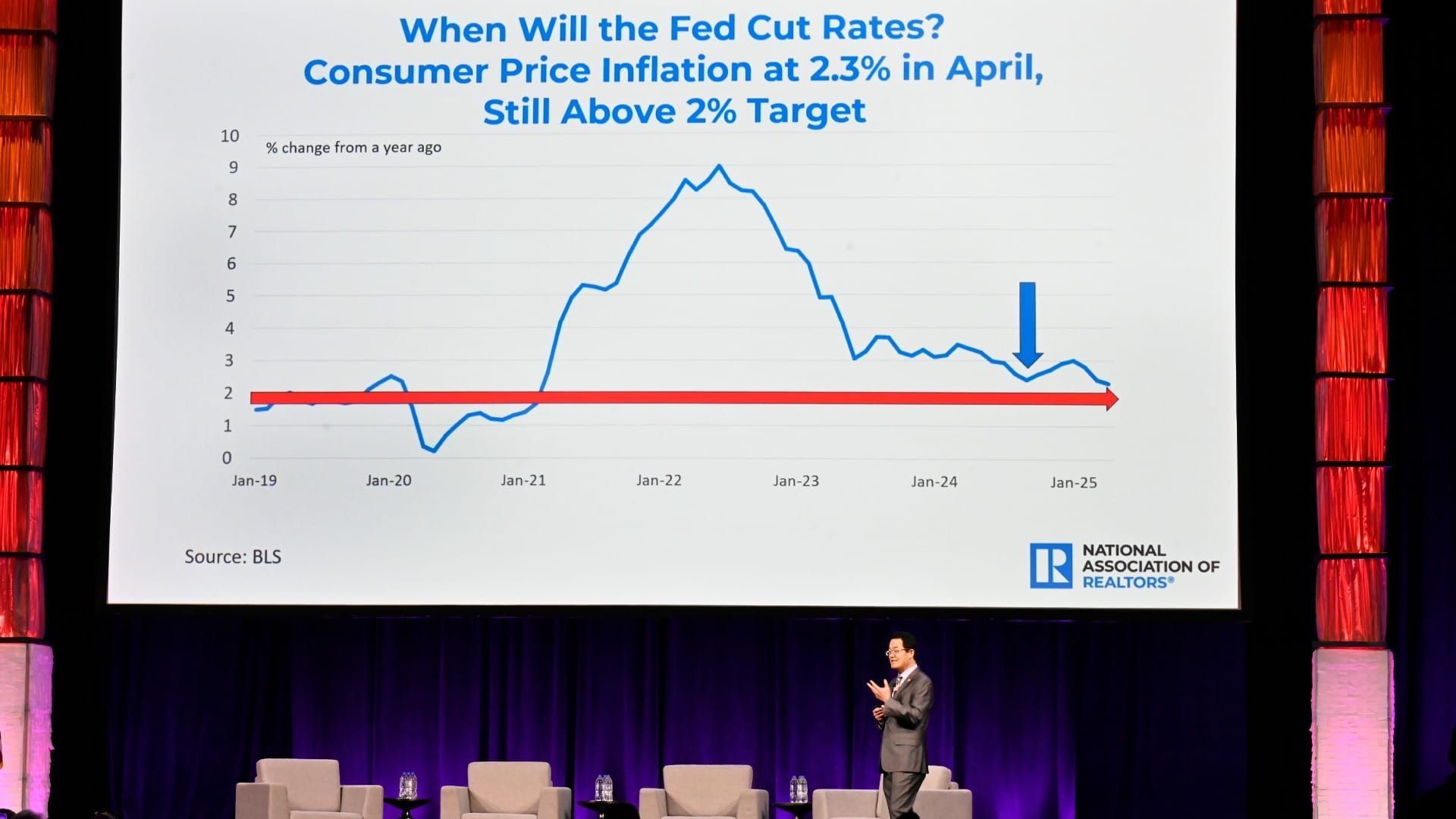
Yun explained that inflation was at 2.3% in April, slightly higher than the Federal Reserve’s 2.0% implicit target, stating, “We’re not there yet, but we’re very close. The Fed will cut interest rates once inflation is fully under control.”
On inflation, Yun pointed out that shelter cost is the heavyweight.
“Only the tariffs’ impact is being discussed. What about other forces that are less discussed? There are other forces out there; for example, the shelter component is the biggest weight to the price component. The shelter cost is already coming down from its recent cyclical peak, and it’s trending downward,” he said.
Yun detailed that the U.S. has experienced better job growth since its pre-pandemic highs in 2020. He also explained that wage growth (3.8%) is outpacing the consumer price index (2.3%).
Regarding the housing market, Yun stated, “Home sales have been very difficult over the past two years. We’ve had the lowest home sales in 30 years for two consecutive years.”
“There’s a light at the end of the tunnel based on recent rises in mortgage applications to buy a home,” Yun added optimistically. “Moreover, a solid majority of renters expressed desire to own a home.”
To view Yun's slide presentation, visit June 2025 Real Estate and Economic Outlook.